India’s warehousing and logistics sector is showing clear signs of recovery in 2026. After a relatively cautious period last year, leasing activity has started gaining momentum again across major logistics markets.
According to the latest industry report, India’s warehousing sector is expected to reach nearly 45 million square feet of annual absorption in 2026, signaling stronger occupier confidence and renewed expansion plans across industries.
The rebound reflects a larger shift happening across India’s supply chain ecosystem. Businesses are focusing more on organized warehousing, faster distribution networks, and operational efficiency.
Q1 2026 Starts on a Stronger Note
India’s top seven cities recorded 11.4 million square feet of warehousing absorption during Q1 2026.
This marked an 8 percent increase compared to the previous quarter, making it the fourth consecutive quarter of sequential growth. That consistency matters.
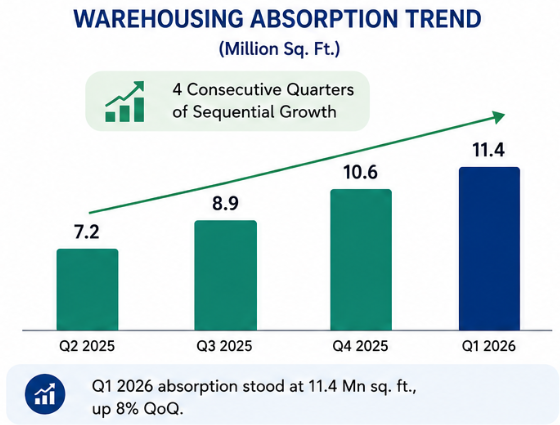
It shows the market is not just experiencing a temporary spike. Demand is gradually stabilizing after the slowdown seen in 2025.
Mumbai and Pune are Leading the Market
Western India emerged as the biggest growth driver during the quarter.
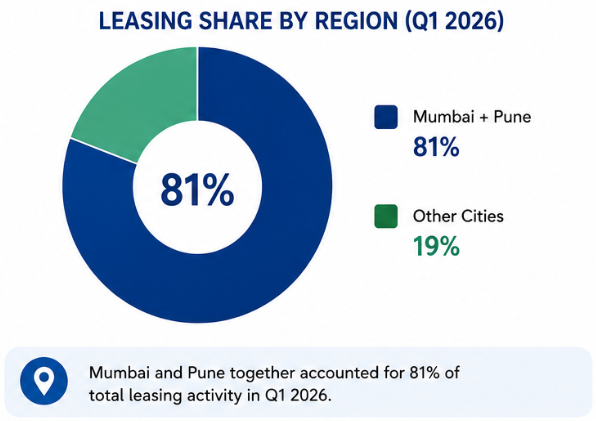
Mumbai and Pune together accounted for 81 percent of total leasing activity in Q1 2026.
That is a massive share.
These cities continue to attract strong warehousing demand because of:
• Established industrial corridors
• Strong transportation connectivity
• Access to consumption markets
• Expanding logistics infrastructure
For occupiers, location efficiency is becoming just as important as warehouse size.
Companies are Prioritizing Better Warehousing Infrastructure
One noticeable trend in 2026 is the growing demand for Grade A warehousing spaces.
Businesses are no longer looking only for storage capacity. They want facilities that improve supply chain performance and operational efficiency.
Occupiers are increasingly focusing on:
• Modern infrastructure
• Better loading and unloading systems
• Efficient transportation access
• Organized logistics parks
• Higher operational reliability
This shift is changing how warehousing spaces are being developed across India.
Demand is being driven by Key Industries
The report highlights that demand is currently being led by:
• Third party logistics companies
• Engineering and manufacturing firms
• Consumer goods businesses
These sectors continue to expand warehousing requirements as distribution networks become larger and more structured.
As consumer expectations around delivery speed increase, companies are also under pressure to optimize inventory movement and regional storage strategies.
That is creating long term demand for organized warehousing infrastructure.
Infrastructure Development is Supporting Growth
Another major reason behind the sector’s recovery is infrastructure expansion.
Improved logistics connectivity is helping warehousing operations become faster and more efficient.
This includes:
• Better road connectivity
• Industrial corridor development
• Growing logistics hubs
• Improved movement between cities
Warehousing growth is no longer happening in isolation. It is closely connected to India’s larger infrastructure expansion plans.
Occupiers are Expanding More Strategically
One of the biggest differences between previous years and 2026 is how companies are approaching expansion.
The focus is now more selective and efficiency driven. Instead of taking large spaces aggressively, occupiers are prioritizing:
• Strategic warehouse locations
• Network optimization
• Operational performance
• Technology enabled logistics management
This creates demand for smarter and more organized warehousing ecosystems.
Annual Absorption could Cross 45 Mn Sq Ft
The report projects that India’s warehousing absorption could touch nearly 45 million square feet by the end of 2026.
That projection reflects growing confidence in the sector’s long term potential.
The growth is being supported by:
• Expanding domestic consumption
• Growing industrial activity
• Rising logistics investments
• Increasing demand for organized warehousing
As supply chains continue evolving, warehousing is becoming one of the most important pillars supporting business operations across industries.
What this means for the Future
India’s warehousing sector is moving into a more organized and infrastructure driven phase.
The rebound seen in Q1 2026 shows that occupier demand remains healthy, especially for modern and strategically located warehousing facilities.
The market is no longer growing only through expansion.
It is growing through smarter logistics planning, stronger infrastructure, and better operational efficiency.
That shift is likely to define the next phase of warehousing growth in India.
Conclusion
India’s logistics and warehousing market has regained momentum in 2026 with improving leasing activity and stronger occupier confidence.
Western markets like Mumbai and Pune continue leading demand, while businesses across industries focus more on operational efficiency and organized warehousing infrastructure.
With annual absorption expected to approach 45 million square feet, the sector is clearly entering a stronger and more structured growth phase.
For businesses planning future expansion, logistics efficiency and warehouse quality will continue playing a critical role in long term operational success.