
India’s office market is entering 2026 with strong demand, expanding Global Capability Centers, growing flexible workspace adoption and a clear shift toward technology enabled and sustainable workplaces.
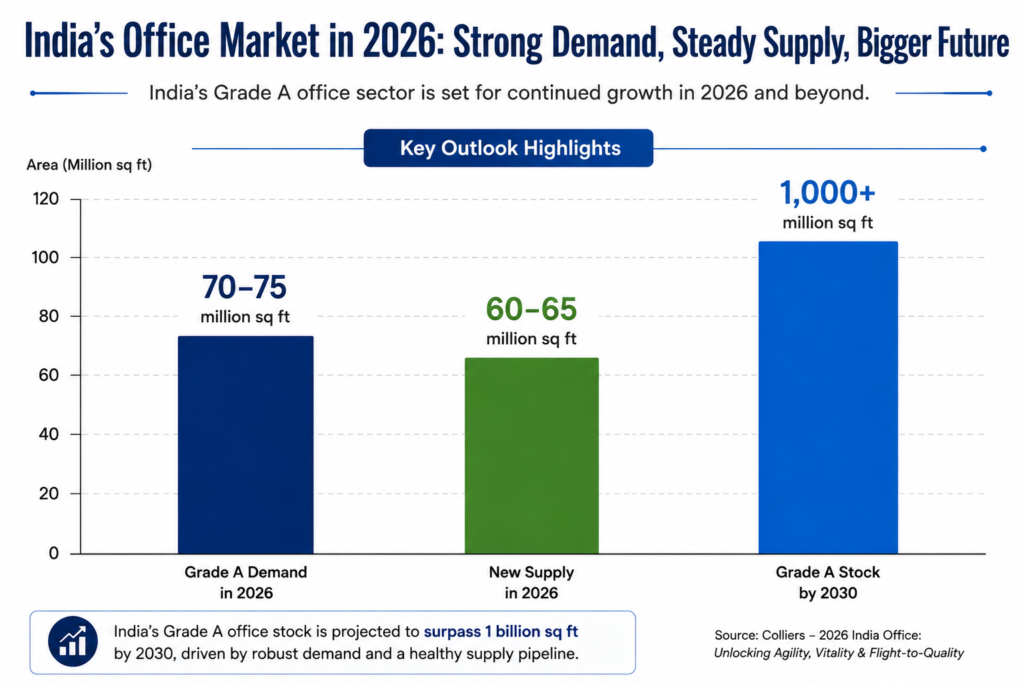
According to Colliers’ 2026 India Office: Unlocking Agility, Vitality & Flight to Quality report, Grade A office demand in India is projected to reach 70 to 75 million sq ft in 2026, while new supply is expected to reach 60 to 65 million sq ft. The market is being shaped by GCC expansion, flexible workspaces, REITs, technology adoption and sustainability.
India’s Office Market Remains Strong
India’s Grade A office market is expected to maintain its growth momentum in 2026. Colliers projects 70 to 75 million sq ft of Grade A demand and 60 to 65 million sq ft of new supply during the year.
The outlook follows two consecutive record breaking years in 2024 and 2025. Colliers expects demand and project completions across most major Indian office markets to remain at similar or higher levels than 2025.
The long term outlook is even stronger. India’s Grade A office stock is expected to surpass 1 billion sq ft by 2030, while average vacancy in leading cities is expected to decline and rentals are likely to firm up further.
Bengaluru Continues to Lead
Bengaluru is expected to remain India’s leading office market in 2026.
Colliers projects the city to account for close to one third of overall leasing activity and supply additions during the year. Hyderabad and Delhi NCR are also expected to remain major contributors, with each projected to record more than 10 million sq ft of demand and new supply.
The concentration of activity across these major markets reflects the continued importance of established technology and business hubs in India’s commercial real estate landscape.
GCCs Become a Major Growth Engine
Global Capability Centers are playing an increasingly important role in India’s office demand.
Colliers expects GCC leasing volumes to reach 30 to 35 million sq ft in 2026, representing around 40 to 50% of Grade A office demand.
GCCs are also changing in nature. Rather than functioning primarily as traditional back offices, they are becoming more innovation driven, specialized and technology integrated centers across sectors such as technology, BFSI, engineering and manufacturing.
Their changing requirements are influencing the type of office space being developed. Colliers expects developers to increasingly focus on modular, scalable and plug and play facilities, particularly as GCCs adopt distributed models involving headquarters, satellite locations and flexible spaces.
Flexible Workspaces Continue to Expand
Flexible offices are becoming a larger part of occupier strategies.
Colliers expects flex operators to lease 15 to 18 million sq ft in 2026, accounting for around 20 to 25% of overall Grade A leasing activity. India’s total flex stock is expected to reach 85 to 90 million sq ft in 2026 and exceed 100 million sq ft by 2027.
The growth is being supported by businesses seeking scalability, cost advantages, risk mitigation and flexibility in response to hybrid working models.
For office operations, this shift also points toward workplaces that need to accommodate changing requirements rather than following a fixed traditional model.
Green Buildings are Moving into the Mainstream
Sustainability is becoming a major factor in India’s office market.
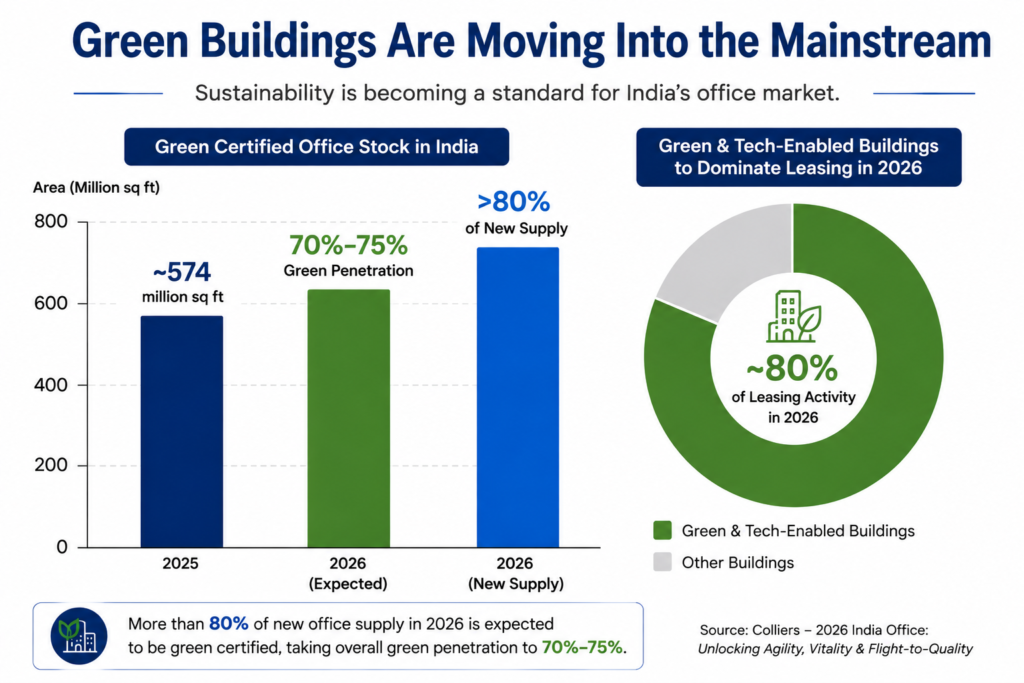
As of 2025, India had approximately 574 million sq ft of green certified office stock, representing nearly two thirds of overall office stock.
The trend is expected to accelerate in 2026. Colliers expects more than 80% of new office supply to be green certified, potentially taking overall green penetration to 70 to 75% across India.
Green and technology integrated buildings are also expected to capture nearly 80% of overall leasing activity in 2026. This suggests that sustainability and technology are increasingly becoming part of occupier expectations rather than optional additions.
Older Offices Present a Major Opportunity
India’s office growth is not limited to new construction.
Colliers identifies significant potential in older office buildings, with more than 420 million sq ft of relatively older office stock, defined as buildings more than 10 years old, having retrofitting potential.
The associated investment opportunity is estimated at more than INR 500 billion.
Retrofitting can therefore become an important part of keeping existing office assets competitive as occupiers increasingly look for technology enabled, sustainable and future ready workplaces.
REITs are Changing Office Ownership
Institutional ownership is another important shift in the market.
Colliers estimates that around 525 million sq ft of existing Grade A office stock is REIT worthy. Of this, approximately 141 million sq ft is already listed under four office REITs.
A further 384 million sq ft has potential to be included in future REITs. Colliers expects REIT penetration to exceed 20% over the coming years, potentially changing how commercial office assets are owned, managed and monetized.
What this Means for India’s Office Sector
The 2026 outlook points to a clear transformation in India’s commercial office market.
Demand is growing, GCCs are taking a larger role, flexible workspaces are expanding, green buildings are becoming more common and technology is increasingly being integrated across the asset lifecycle.
For facility management, these changes make building operations increasingly important. Technology enabled workplaces, sustainable assets, flexible occupancy models and larger Grade A portfolios require structured operations, reliable maintenance, efficient resource management and a strong focus on occupant experience.
The office of the future is therefore not simply about having more space. It is about creating better performing, flexible, sustainable and technology enabled workplaces.
With Grade A demand expected at 70 to 75 million sq ft in 2026, GCCs potentially accounting for 40 to 50% of that demand, and more than 80% of new supply expected to be green certified, India’s office market is moving into a new phase of growth and institutionalization.
Source: https://www.colliers.com/en-in/news/press-release-india-office-outlook-2026