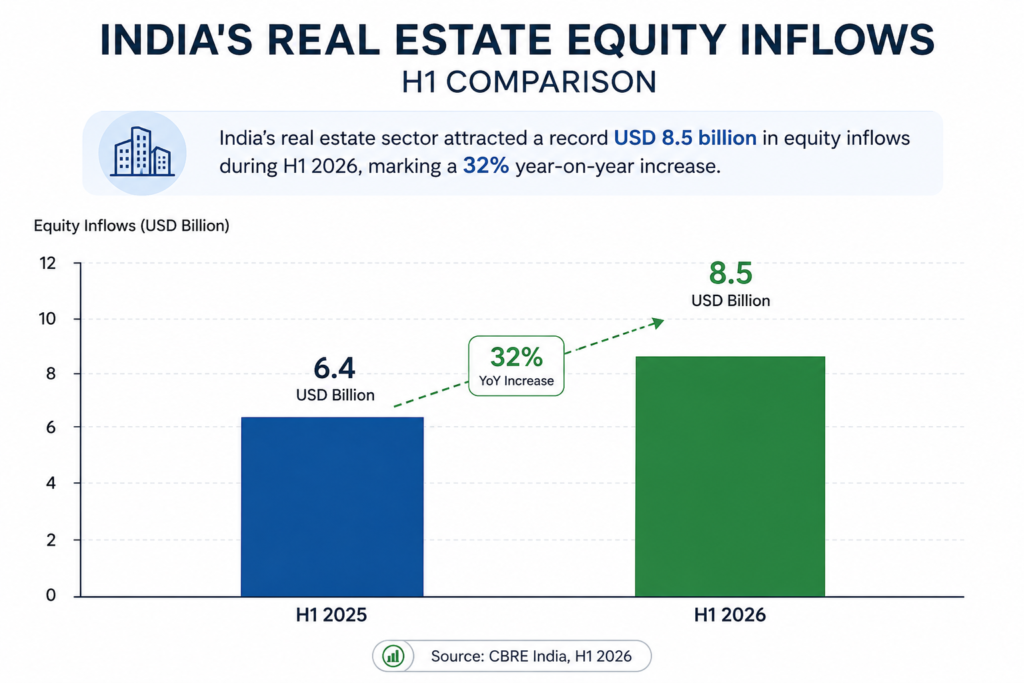
India’s real estate market has reached another major milestone. According to the latest CBRE report, the sector attracted USD 8.5 billion in equity capital during the first half (H1) of 2026, making it the highest-ever equity inflow recorded for the period. This represents a 32% year-on-year increase over the USD 6.4 billion invested during H1 2025.
The strong inflow reflects growing investor confidence in India’s long-term real estate fundamentals. Commercial office assets, land acquisitions, and residential development projects continue to attract substantial institutional investments despite global economic uncertainties.
For facility management companies, developers, and commercial property owners, this surge in investment signals continued demand for professionally managed, sustainable, and future-ready buildings.
H1 2026 Sets a New Investment Record
The Indian real estate sector recorded USD 8.5 billion in equity inflows during the first six months of 2026. Stable economic growth, increasing demand for quality commercial spaces, and strong land acquisitions have contributed significantly to this performance.
Compared to the USD 6.4 billion recorded during H1 2025, this year’s performance marks an impressive 32% increase, highlighting the resilience of India’s property market.
The record investment demonstrates that institutional investors continue to view Indian real estate as a stable and attractive long-term asset class.
Office Assets and Land Development Dominated Investments
One of the strongest trends emerging from the report is the growing preference for built-up office assets and land/development sites.
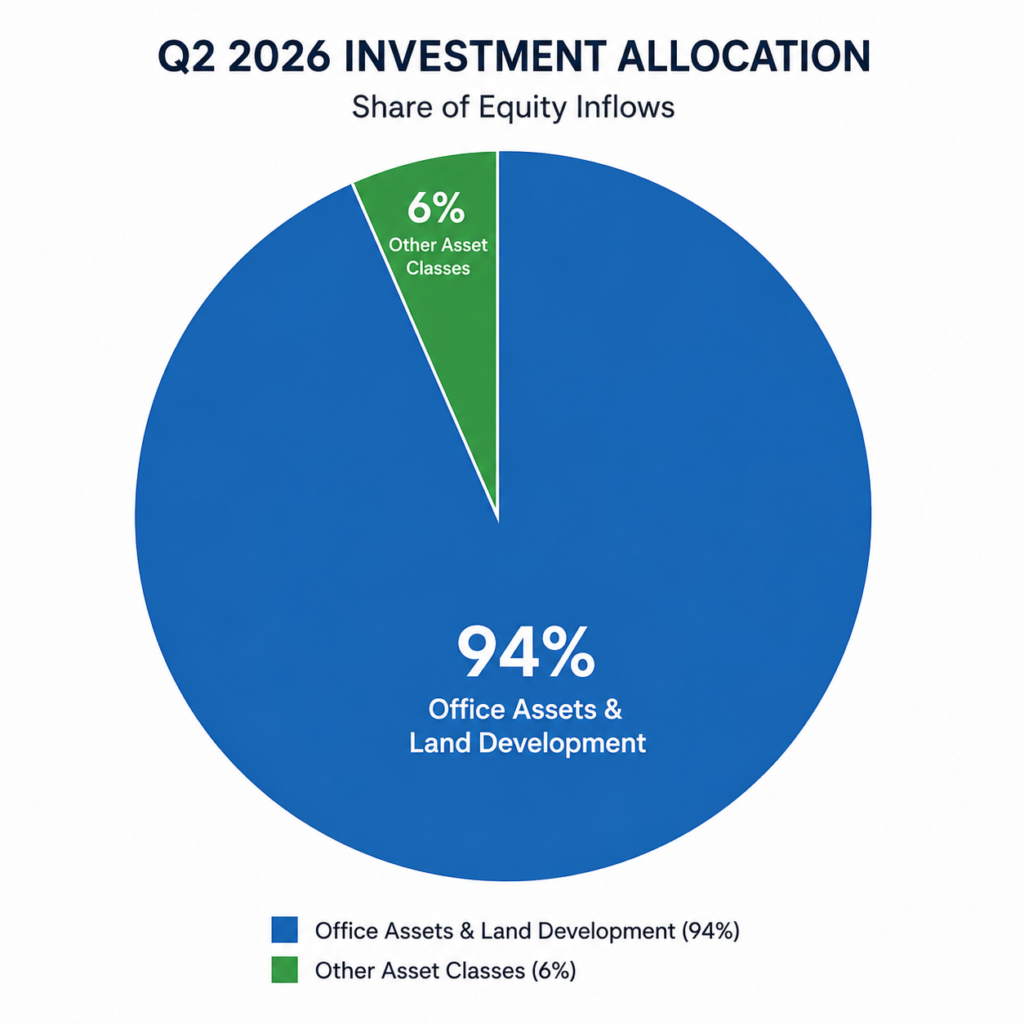
During the second quarter (Q2) of 2026 alone, India attracted approximately USD 3.4 billion in equity inflows. Remarkably, 94% of this capital was invested in land acquisitions and office assets, underlining investors’ confidence in commercial real estate and future development opportunities.
This trend reflects increasing demand for Grade A office spaces, business parks, mixed-use developments, and premium residential projects across India’s leading metropolitan cities.
Bengaluru, Delhi-NCR and Mumbai Continue to Lead
India’s top three commercial real estate markets—Bengaluru, Delhi-NCR, and Mumbai—accounted for nearly 60% of total investment inflows during Q2 2026.
These cities continue to benefit from:
- Strong office leasing demand
- Expansion of Global Capability Centres (GCCs)
- Growth in IT and technology sectors
- Large-scale infrastructure development
- Increasing institutional investment
As businesses continue expanding operations, demand for professionally managed commercial buildings is expected to rise alongside investment activity.
Domestic Investors Are Driving the Growth
An important highlight from the CBRE report is the increasing role of domestic capital.
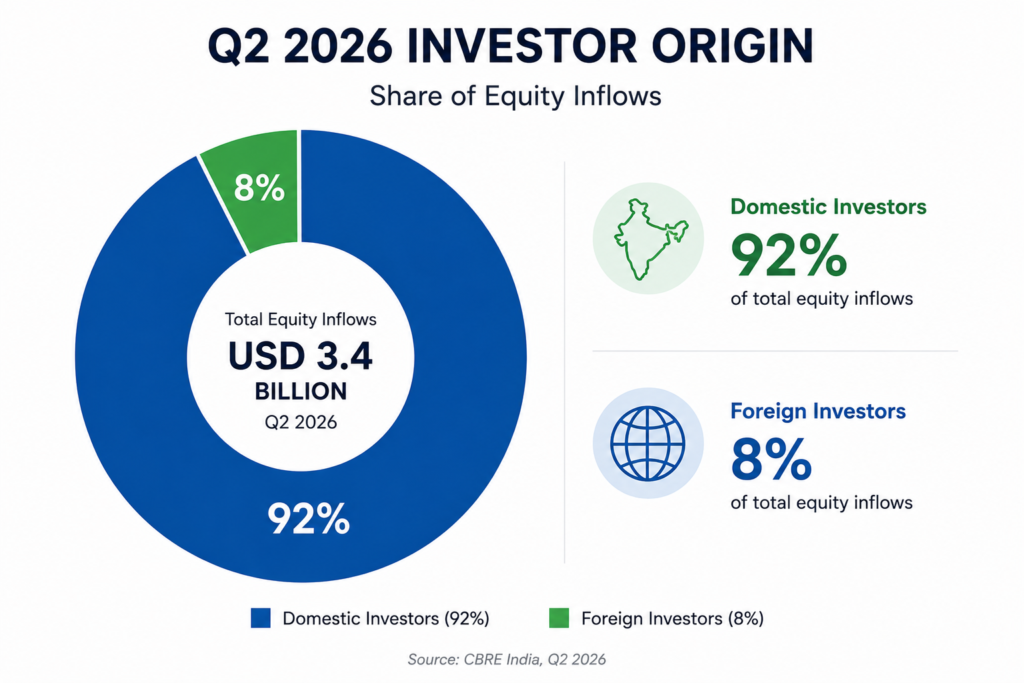
Domestic investors contributed approximately 92% of total investment inflows during Q2 2026, demonstrating strong confidence in India’s long-term growth potential.
Among the major contributors:
- Developers accounted for 34% of total capital deployment.
- Domestic institutional investors contributed 32%.
- Institutional investment increased 51% quarter-on-quarter, indicating sustained participation from financial institutions.
The growing participation of domestic investors has helped maintain investment momentum despite fluctuations in global capital markets.
Residential and Office Projects Continue to Attract Capital
The report also highlights that more than 88% of investment into land and site acquisitions was directed towards residential and office developments.
Meanwhile, the remaining investments were allocated across:
- Data centres
- Industrial and logistics parks
- Mixed-use developments
In addition, approximately USD 1.6 billion worth of investment and development platforms were established in the residential and office sectors, indicating sustained confidence in long-term project development.
What Lies Ahead?
CBRE expects the positive momentum to continue throughout the remainder of 2026.
The report suggests that continued domestic participation, coupled with the expected return of foreign capital as global economic conditions stabilize, could further strengthen India’s real estate investment landscape.
Growing investment activity across office developments, residential projects, and strategic land acquisitions indicates that investors remain optimistic about India’s long-term economic outlook.
With a strong pipeline of projects, increasing institutional participation, and sustained demand across key property segments, the Indian real estate sector appears well-positioned to maintain its growth trajectory in the coming months.
Frequently Asked Questions (FAQs)
1. How much equity investment did India’s real estate sector receive in H1 2026?
According to CBRE, India’s real estate sector attracted a record USD 8.5 billion in equity inflows during the first half of 2026.
2. What was the year-on-year growth in investment?
Equity inflows increased by 32%, rising from USD 6.4 billion in H1 2025 to USD 8.5 billion in H1 2026.
3. Which asset classes attracted the highest investment?
Land acquisitions, development sites, and built-up office assets accounted for approximately 94% of Q2 2026 equity inflows.
4. Which cities received the largest share of investments?
Bengaluru, Delhi-NCR, and Mumbai together accounted for about 60% of investment inflows during Q2 2026.
5. Who were the major investors in Q2 2026?
Domestic investors contributed 92% of total investment inflows, with developers accounting for 34% and domestic institutional investors contributing 32% of total capital deployment.
6. Which sectors received the majority of land acquisition investments?
More than 88% of land and site acquisition investments were directed towards residential and office developments, while the remaining investments were allocated to data centres, industrial & logistics, and mixed-use projects.