Commercial cleaning is becoming an increasingly important part of modern facility management. Businesses are looking beyond basic cleaning and placing greater emphasis on hygiene, safety, operational efficiency, sustainability and service quality.
According to the latest Commercial Cleaning Services Market: Global Strategic Business Report by Research and Markets, the global commercial cleaning services market was valued at US$220.3 billion in 2024 and is projected to reach US$289.2 billion by 2030, growing at a 4.6% CAGR from 2024 to 2030. The report was published in August 2026 and covers major global markets, service segments and applications.
Global Market Growth
The market is expected to grow by almost US$69 billion between 2024 and 2030.
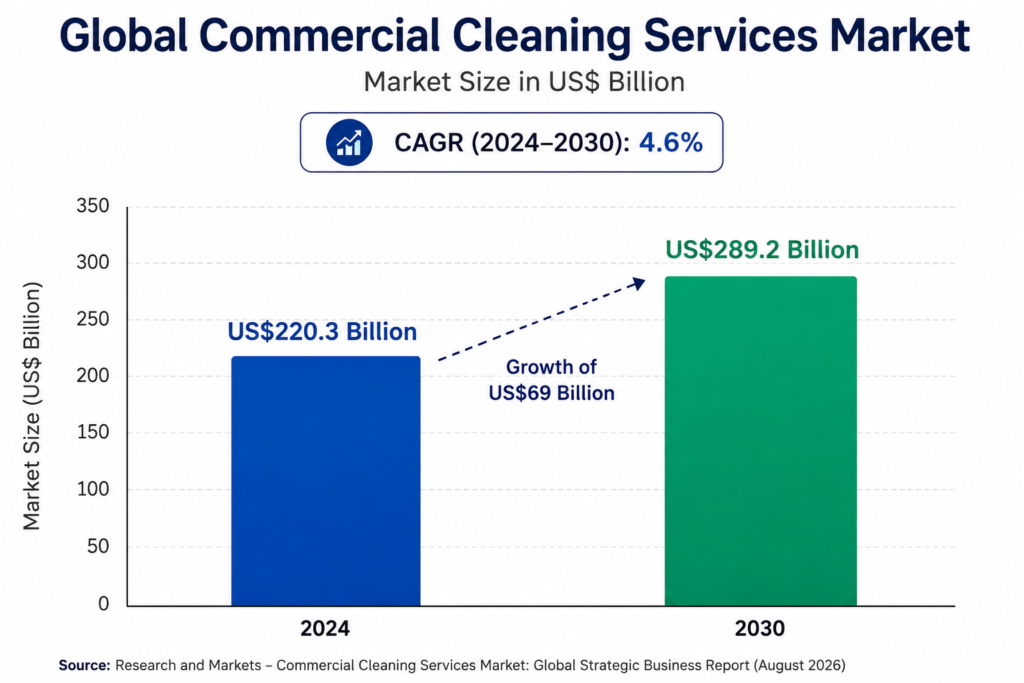
The report links this growth to increased awareness of workplace hygiene, regulatory expectations and the need for safe, healthy and compliant environments. The shift toward third party professional cleaning contracts is also contributing to market expansion.
Why Professional Cleaning is Growing?
Commercial cleaning now covers a wide range of services, including janitorial services, window and carpet cleaning, disinfection, hard floor care, restroom sanitation and post construction cleanup.
The report notes that cleaning has become particularly important across sectors such as healthcare, education, retail, hospitality and corporate offices.
Healthcare facilities require frequent and specialized cleaning because of infection control requirements and regulatory scrutiny. Corporate offices are adapting cleaning schedules to changing occupancy patterns, while educational institutions, airports, retail chains and industrial facilities require cleaning programs suited to their specific operating environments.
This is pushing organizations toward more customized cleaning programs rather than standard routines.
Outsourcing is Driving Demand
One of the key market drivers identified in the report is the shift toward third party professional cleaning contracts.
Businesses are increasingly using specialized providers for trained workforce deployment, professional equipment and cleaning techniques. The report also identifies scalability, cost efficiency and risk management as factors influencing outsourcing decisions.
Another important development is the growth of integrated facility management, where cleaning can be combined with services such as security, HVAC and maintenance.
For large organizations, this approach can help consolidate vendors and improve operational visibility across facilities.
Technology is Changing Cleaning Operations
Technology is becoming an important part of commercial cleaning.
The report highlights the growing adoption of IoT enabled equipment, automated floor scrubbers and robotic vacuum cleaners, particularly in large facilities. These technologies can support operational efficiency and data driven performance monitoring.
Digital platforms are also being used to schedule cleaning tasks, manage staff workflows and record compliance activities in real time.
Mobile applications and cloud platforms are supporting real time monitoring and reporting of service quality. This allows facility teams to gain greater visibility into cleaning activities instead of depending entirely on manual supervision.
Sustainability is Reshaping Commercial Cleaning
The market is also moving toward more sustainable cleaning practices.
Research and Markets highlights the adoption of biodegradable chemicals, microfiber cleaning systems and equipment designed to reduce water and energy consumption. The report also identifies electrostatic sprayers, UV disinfection tools and chemical free steam cleaners among emerging technologies being used in the sector.
Green cleaning is particularly relevant to organizations with sustainability, ESG and employee wellness objectives.
The focus is therefore shifting toward cleaning solutions that support both facility performance and environmental goals.
Asia Pacific is Gaining Momentum
North America and Europe remain mature commercial cleaning markets, while Asia Pacific is experiencing strong demand growth.
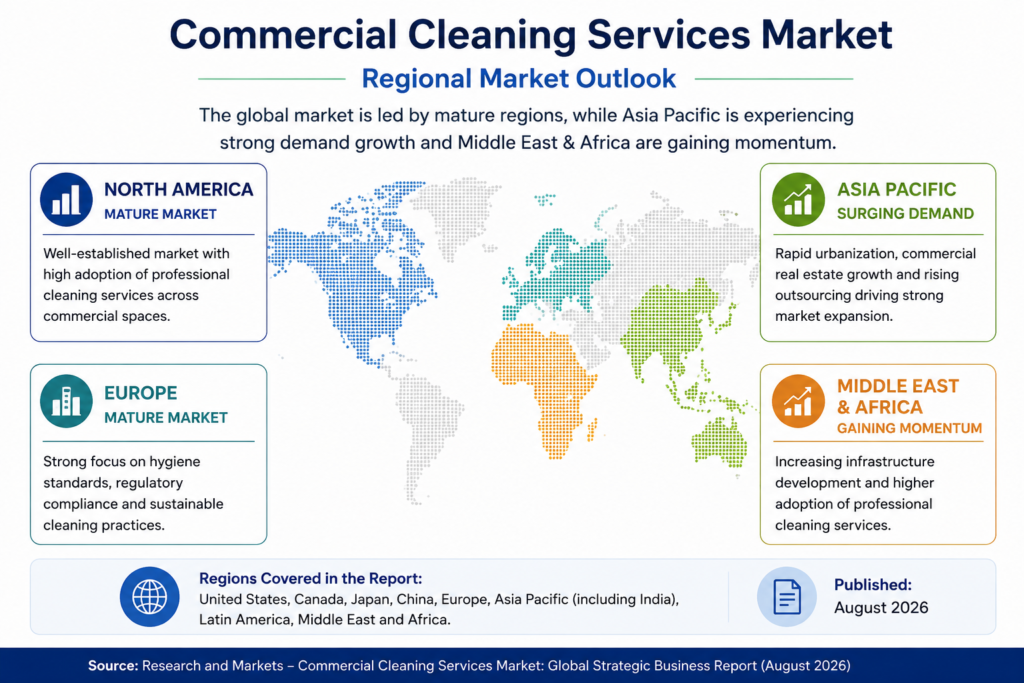
The report attributes this growth to urban expansion, rising commercial real estate construction and increased outsourcing of facility management. It specifically identifies China, India and Southeast Asia as important markets within the region.
The report also identifies the Middle East and Africa as markets gaining momentum as global businesses expand their presence and commercial spaces increasingly adopt internationally benchmarked hygiene standards.
Show a visual highlighting North America and Europe as mature markets, Asia Pacific as a high growth region, and Middle East and Africa as emerging markets.
The publicly available report summary does not provide individual market values for every region, so regional percentages should not be added without accessing the full report.
China Shows Strong Growth
The report provides specific figures for selected markets.
The United States commercial cleaning services market was valued at US$60 billion in 2024.
China is projected to reach US$56.4 billion by 2030, with a 7.3% CAGR during the forecast period.
Window Cleaning is a Major Segment
The report divides the commercial cleaning services market into several service categories:
- Window cleaning services
- Vacuuming services
- Floor care services
- Maid services
- Carpet and upholstery services
- Other services
Among these segments, window cleaning services are projected to reach US$73.9 billion by 2030, growing at a 4% CAGR.
The vacuuming services segment is projected to grow at a 3.5% CAGR during the analysis period.
These figures highlight how broad the commercial cleaning market has become, with demand spread across multiple specialized services.
What is Driving the Next Phase of Growth?
The report identifies several trends shaping the market through 2030.
These include stricter cleaning and disinfection standards, expansion of healthcare, hospitality and retail infrastructure, outsourced facility management, green cleaning, robotics and IoT, high traffic commercial buildings, indoor environmental health, industrial and warehouse expansion, ESG programs and real time service monitoring.
Subscription based and on demand cleaning models are also expanding, while mobile applications and cloud platforms are supporting greater transparency in service delivery. Hybrid workplaces and coworking spaces are creating demand for more flexible cleaning schedules.
What this means for Facility Management?
The commercial cleaning industry is moving from routine service delivery toward measurable, technology enabled and sustainability focused operations.
For facility managers, the focus is no longer simply whether a space has been cleaned. Service quality, scheduling, workforce management, reporting, sustainability and operational requirements are becoming increasingly connected.
The numbers demonstrate the scale of this shift.
A global market growing from US$220.3 billion in 2024 to US$289.2 billion by 2030, combined with technological adoption and increasing outsourcing, shows that commercial cleaning is becoming an increasingly significant part of the wider facility management ecosystem.
For offices, healthcare facilities, educational institutions, industrial spaces and commercial properties, professional cleaning is becoming more closely connected to the overall performance of the facility.
Commercial cleaning is no longer just about keeping a space clean. It is becoming part of how modern facilities operate.